← Back to MUSE Ecosystem
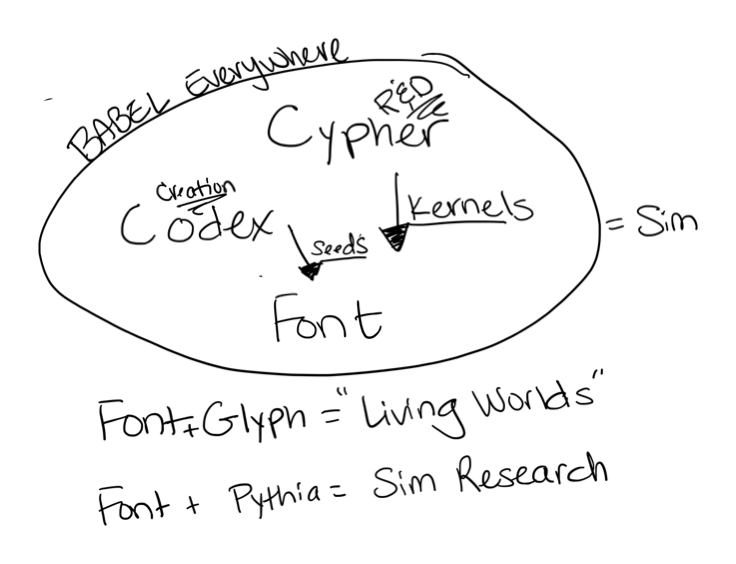
Fig. 1: Early design sketch — FONT ecosystem architecture
MUSE Ecosystem · Gothic Grandma LLC
FONT
Simulation Engine
Key Achievement: 13.7× real-time compression at 100K entities · 5.8ms per kernel fire (GPU) · Full determinism for replay and debugging
What Problem It Solves
Traditional game engines handle ~1,000 scripted NPCs. Achieving emergent behavior at scale—where characters genuinely perceive, decide, and adapt based on biological and psychological systems—requires fundamentally different architecture.
FONT is designed for 100,000+ concurrent entities with emergent behavior, using infrastructure-style patterns: temporal distribution of computation, pre-filtered batch execution, and distributed timing across GPU kernels.
How It Works
Burst Computation Processing 100K+ Entities in Milliseconds
- Burst computation on prompts — processes 100,000+ entities in milliseconds when user acts
- Efficient by design — idle when paused, no wasted cycles on continuous rendering
- Scales independently — simulation complexity grows with world richness, not interaction frequency
Visual Design → Schema → Platform-Specific GPU Kernels
- Visual design — build systems in TESSERA (node graph editor embedded in GLYPH)
- Schema storage — graph saved as JSON to Supabase database
- GESTALT compilation — schema transforms to platform-specific source (.cu/.metal/.comp)
- Binary generation — compiled to optimized binaries (.ptx/.metallib/.spv)
- Runtime execution — event-driven scheduler dispatches kernels based on biological timing; each kernel gets its own deltaTime
HOT/WARM/COLD Data Tiers with Structure-of-Arrays Layout
- HOT data — values updated every kernel execution (position, velocity, current state)
- WARM data — confidence scores, timestamps, belief changes
- COLD data — investigation metadata (difficulty, sources, rarely accessed)
- Structure-of-Arrays — cache-efficient memory layout for GPU batch processing
Metal, CUDA, Vulkan + CPU SIMD Fallback
- Metal — primary backend for macOS development
- CUDA — NVIDIA GPU acceleration
- Vulkan — cross-platform compute shaders
- CPU SIMD fallback — graceful degradation when GPU unavailable
- VRAM-backed detail tables — shared across kernels, preventing data duplication
Key Systems Design
- Unified all entity types under single kernel execution model using exclusion-based system masks
- Eliminated per-frame entity filtering via event-driven kernel membership updates
- Designed VRAM-backed detail tables shared across kernels preventing data duplication
- Implemented deterministic stepping, snapshotting, and replay for debugging and time-travel inspection
Scientifically Grounded
- Based on embodied cognition research — not game AI heuristics, actual perceptual and motor control models
- Biological timing — systems execute at realistic rates (50ms reflexes, 1000ms deliberation)
- Emergent complexity — societies, economies, cultures arise from simple rules at scale
- Transparent models — no black boxes; every system is inspectable, verifiable, traceable
Benchmarks (Apple M4 Pro, 100K entities)
- 13.7× real-time compression — 600 simulated seconds advance in 43.8 wall-clock seconds
- GPU kernels: ~5.8ms per fire at 100K entities (58 ns per entity). Metal dispatch overhead (~0.5–1ms) dominates — actual GPU arithmetic takes ~0.025ms.
- CPU scalar kernels: 0.73ms per fire at 100K entities (7 ns per entity). CPU wins below ~70K entities/kernel where GPU dispatch overhead isn't amortized.
- Memory scaling — 50 systems × 40 details = 2,000 SoA arrays. At 16GB RAM: ~1.4M entities; at 64GB: ~5.9M; at 248GB: ~23M.
- Projected 50-system world at 100K entities: 15–50× real-time compression with async GPU batching
Impact
- Orders-of-magnitude scale improvement over traditional game engine NPC limits
- Event-driven scheduler means each kernel fires at its biological rate independently — no fixed simulation step
- Full determinism enables replay, debugging, and scientific reproducibility
- Schema-driven architecture allows non-programmers to design biological systems that compile to GPU code
WebSocket Server on Port 7777
- Port 7777 — real-time simulation control and state streaming
- Permission-based commands — tools get different access levels
- Command dispatch — 30+ commands for registry queries, entity management, hotfixes